

The Cost of Narrative Debt
Why Your Evolving Brand sends Contradictory Signals to Funders
Walk through any old city and you can read its history on the walls. A facade tells you what era it was built, what it survived, who decided it needed fixing and when. Look closely enough at an old brick house, one stood for a hundred years or more, and you start to notice the seams. A new wing added decades after the original frame. A patch where a leak once ran, the brick a slightly different shade. A tangle of wiring threaded through walls that were never built to hold it. None of it was wrong, exactly. Each addition solved a real problem at the time. But stand back far enough and the house stops reading as one structure. It reads as a sequence of decisions, layered on top of each other, each one slightly out of conversation with the last.

Philadelphia Rowhouse Bright MLS via BHHS Fox & Roach Realtors
Institutions do this to their own stories. Not all at once, and never carelessly: a line gets added to the pitch deck because an anchor funder asked for it; the website gets updated for a new program launch; the language shifts, gradually, to keep pace with how the field talks now. Each change is reasonable. But the accumulation is what I started calling narrative debt: years of small, necessary edits that, taken together, no longer describe one coherent thing. The mission is still there, underneath. But what's visible from the outside is closer to the house, functional, explainable room by room, and faintly chaotic as a whole.
Here's what that looks like in practice. An NGO spent five years adjusting its core presentation to satisfy three different legacy grant requirements. A slide here, a framework there, a line of language borrowed from whichever funder mattered most that year. The deck still works, technically. Every slide can be defended, but hand it to a new anchor funder and watch them try to find the throughline. They can't, because there isn't one anymore, there's a record of who the organization has been answering to, stacked in the order they asked.
Or: a network that started as a grassroots effort in one city expands across continents, takes on new partners, starts managing real capital, but keeps telling its story the way it did at the local stage. The expansion is real. The storytelling hasn't caught up. To an institutional partner deciding whether this organization can handle scale, that gap reads as an answer before anyone says a word.
Or: a legacy institution launches something genuinely new, a tech-driven initiative, a modern program that represents real internal change. Yet, its messaging, its public-facing voice are still the ones from twenty years ago. The new thing exists. But nothing on the outside signals it's allowed to.
In each case, no one inside the organization necessarily sees the gap. They were there for every individual decision, and every decision made sense. It's only externally, from the position of someone deciding whether to fund, partner with, or collaborate with the organization, that the dissonance becomes legible. And it is legible, even when it can't quite be named. A funder doesn't usually think "this organization has narrative debt." They think something quieter and harder to shake: something here doesn't add up. No amount of clean financial data fully answers that feeling, because the feeling isn't about the numbers.
I think about this the way I was trained to look at images, where form and content cannot be separated, where the choice of color or composition is never just decoration, it's already making an argument whether the artist intended it or not. A brand, a pitch deck, a website: these aren't just containers for an organization's story. They are part of the story, whether anyone designed them to be or not.
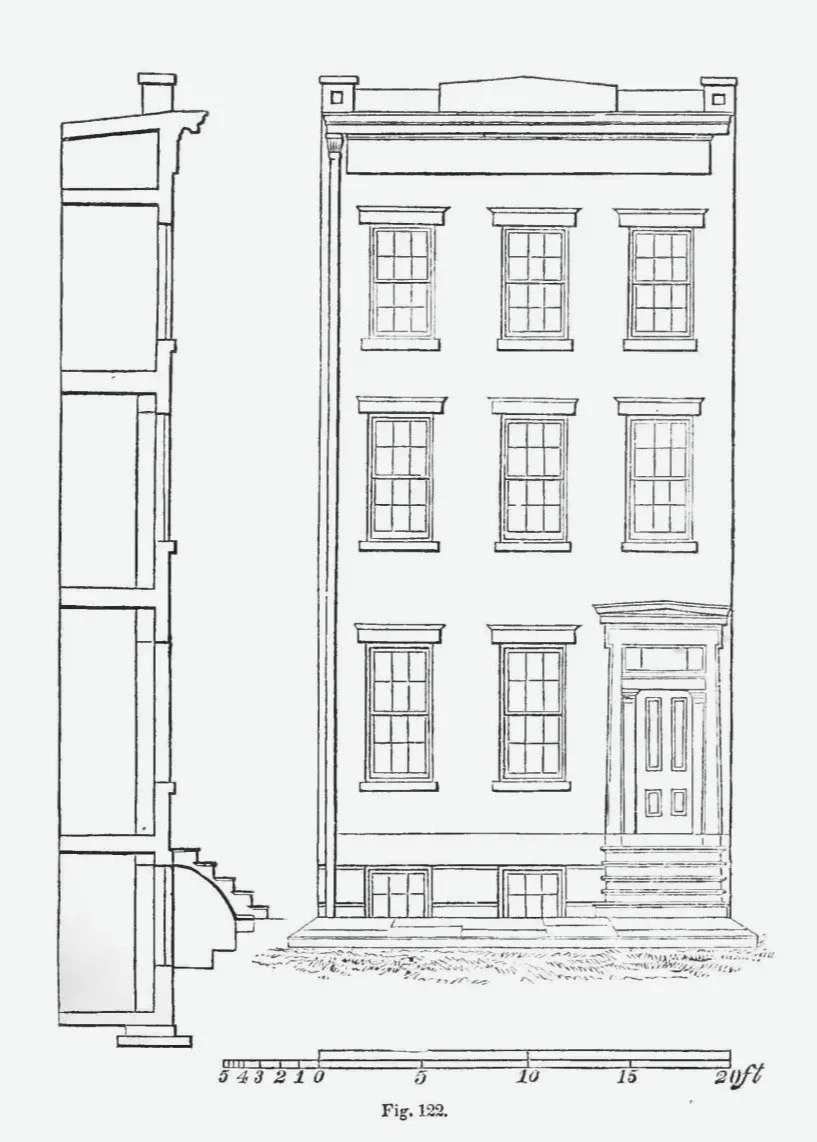
1844 Rowhouse
by Robert G. Hatfield via The American House-Carpenter
Which is why I push back a little on the instinct to call in a marketing agency first. Copywriting is choosing a new paint color, picking better trim. It matters, facades matter, but no amount of it fixes a foundation that has settled unevenly. Narrative Architecture is what happens before the paint: the structural work of making sure the story underneath can actually support what you're trying to build on top of it. That it can scale into new markets without cracking, survive the kind of close reading a major funder's due diligence team is paid to do, and hold together as one thing rather than a record of every decision that led here.
In practice, that means going back through the layers, not to erase them, but to find the original through-line underneath all the patches, the thing that was true before the accumulation started. It means making sure that every touchpoint, from an executive's talking points to the language on a brief, is reinforcing the same foundational logic rather than each pursuing its own. And it means making the real complexity of the work legible at a glance, so those deciding whether to invest don't have to reconcile it themselves.
A fractured story doesn't mean a failed mission. Most of the organizations I described above are doing real work, work that matters. Yet a fractured story creates a ceiling for what that work can become; the people who help it grow may not always see it clearly enough to act.
So before the next campaign, the next rebrand, the next round of copy, it might be worth walking through your own house. Not looking for what's broken. Looking for the seams.
